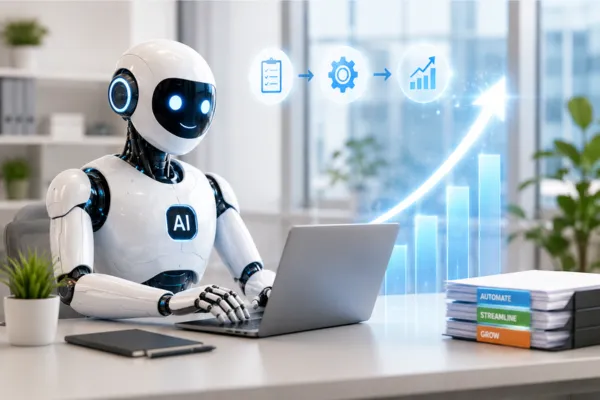
The Efficiency Filter: Why Businesses Replacing Busywork With AI Are Pulling Ahead
The Efficiency Filter: Why Businesses Replacing Busywork With AI Are Pulling Ahead

We are entering a new economic divide—one that is no longer defined by company size, funding, or even talent alone, but by how effectively an organization eliminates busywork and scales intelligence through automation.
Across industries, a quiet but powerful shift is underway. The businesses that are growing fastest are not simply working harder—they are working differently. They are using AI to remove operational friction, streamline repetitive tasks, and reallocate human effort toward high-value thinking, creativity, and strategy.
This is the new “efficiency filter.” And it is separating organizations that scale from those that stall.
The End of Routine Work as We Know It
Nearly half of all workplace activities—especially those tied to data entry, documentation, reporting, and routine coordination—are increasingly automatable.
What was once accepted as “normal workload” is now becoming unnecessary friction.
Forward-thinking organizations are already applying AI to eliminate operational drag:
Administrative automation: scheduling, document handling, invoicing, and record updates
Content and workflow intelligence: AI-assisted writing, analysis, and code generation
Customer interaction systems: automated support handling a majority of routine inquiries
The result is not just efficiency—it is organizational acceleration. Teams are no longer buried in repetitive tasks and can instead focus on execution that drives growth.
The Productivity Gap Is Already Visible
Organizations integrating AI into workflows are reporting significant productivity gains, with studies showing average improvements of up to 60%+ in task efficiency depending on role and implementation.
This advantage comes from a simple reality:
AI operates continuously without fatigue
It processes structured data with high consistency and low error rates
It executes repetitive workflows at scale and speed impossible for human labor
In contrast, human teams are most valuable not in repetition—but in judgment, creativity, and decision-making.
The Rise of the Human Premium
As AI absorbs technical execution, the value of distinctly human capabilities is increasing.
Skills such as:
Strategic thinking
Emotional intelligence
Leadership and communication
Complex problem-solving
Ethical decision-making
…are becoming more valuable, not less.
The future of work is not “human vs. machine.” It is human amplified by machine.
The most successful organizations are not replacing people—they are restructuring roles, delegating repetitive work to AI while elevating humans into higher-order responsibilities.
What Smart Businesses Are Doing Now
Organizations that are pulling ahead are adopting three core shifts:
1. Auditing Workflows, Not Just Employees
They identify which tasks are repetitive, automatable, and low-value—and systematically remove them.
2. Building AI-Literate Teams
Continuous learning is no longer optional. Teams are trained to understand, use, and collaborate with AI systems effectively.
3. Shifting to Agile, Cross-Functional Structures
Rigid hierarchies are being replaced with flexible, fast-moving teams designed for rapid decision-making and iteration.
The Bottom Line
We are moving toward a world where efficiency determines survival—and intelligence is no longer limited to human effort alone.
Businesses that cling to outdated workflows will fall behind not because they lack talent, but because they are weighed down by unnecessary work.
Those that embrace automation are not just improving productivity—they are redesigning how work itself is done.
Final Thought
The future does not belong to those who resist change.
It belongs to those who remove friction, scale intelligence, and align human creativity with machine efficiency.
Stop optimizing busywork.
Start designing systems that think, execute, and evolve.
📍 Pembroke Pines • Miramar • Weston • Sunrise • Davie
🔗 nextlevelachieved.com
#AI #Automation #FutureOfWork #BusinessStrategy #Leadership #DigitalTransformation #NextLevelAchieved
