Don’t Just Automate the Mess: Why Process Before Platform Matters
Don’t Just Automate the Mess
Why “Process Before Platform” Is Your Ultimate Defense Against Technological Chaos

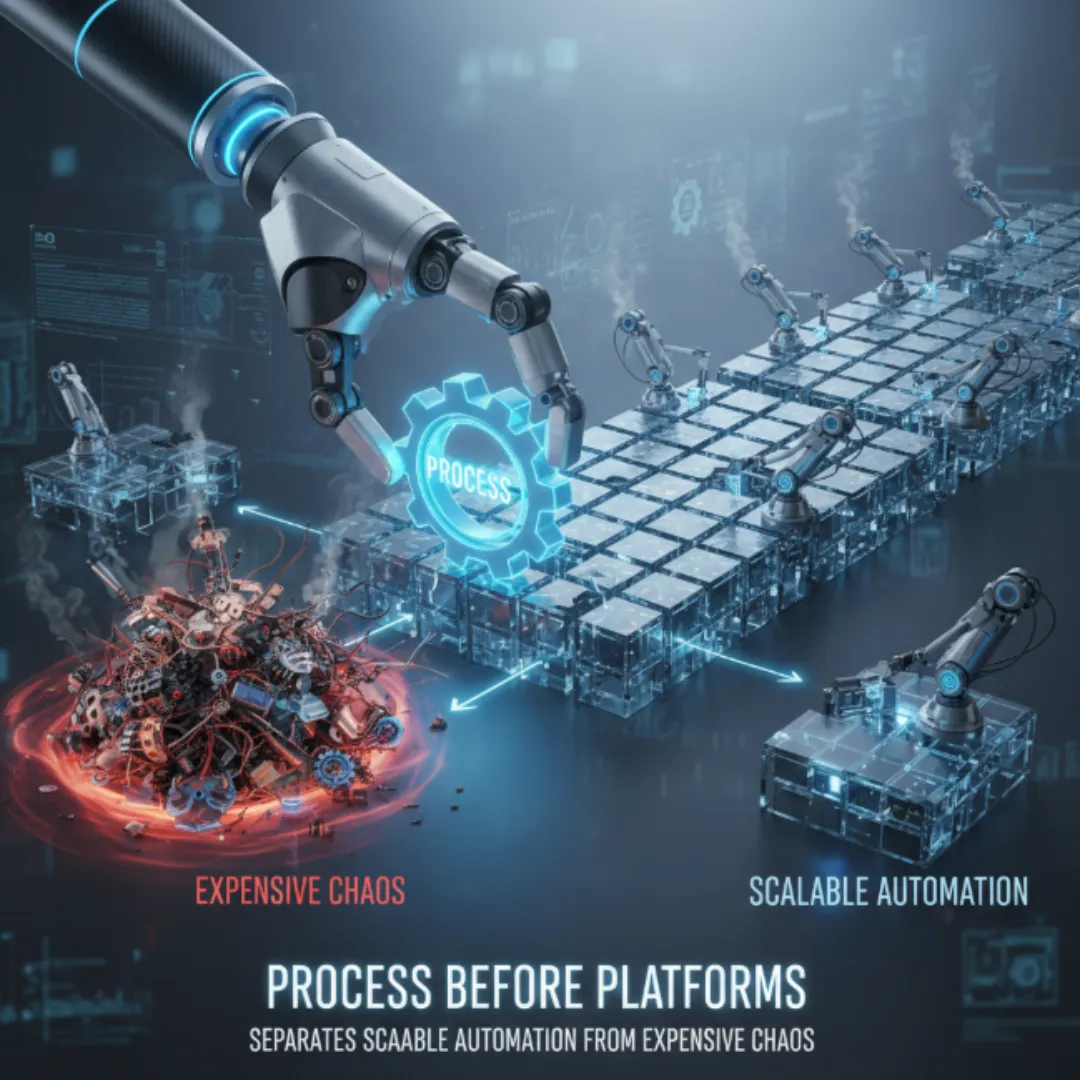
Process Optimization Visual
The Strategy of Process Before Platform
In the race to modernize, many organizations make a costly mistake: they buy technology first and ask strategic questions later.
This article advocates for a simple but powerful principle—Process Before Platform—a strategy that separates scalable automation from expensive digital failure. The core idea is straightforward: understand, map, and optimize workflows before selecting or implementing any technology.
When businesses skip this step, automation doesn’t solve problems—it multiplies them.
The Core Truth
Automating a broken process only accelerates its brokenness.
Technology is an amplifier. If the underlying workflow is inefficient, unclear, or misaligned, automation simply helps it fail faster and at a larger scale.
The Golden Rule
Meticulously map and optimize workflows before considering a platform.
Before automating anything, organizations must ask a more fundamental question:
Does this process deserve to exist at all?
“Before automating anything, ask whether it should exist at all. The fastest process is the one you eliminate entirely.”
— Timothy Osirike
Practical Steps to Embrace “Process Before Platform”
Turning principle into practice requires discipline and clarity.
1. Map It Out
Visualize every step, decision point, and handoff. If a process can’t be explained clearly, it shouldn’t be automated.
2. Spot the Snags
Identify bottlenecks, delays, and redundancies before digitization—not after rollout.
3. Know Your “Why”
Define success metrics upfront: faster decisions, fewer errors, reduced cost, or improved customer experience.
4. Streamline First
Challenge legacy habits. Many workflows exist simply because “that’s how it’s always been done.”
5. Technology as a Sidekick
Tools should adapt to the process—not force the process to bend around the tool.
6. Preserve Human Touchpoints
Automation should empower people, not erase empathy or accountability.
7. One Source of Truth
Integrated systems prevent data silos, duplication, and conflicting insights.
8. Measure ROI Relentlessly
Track outcomes against defined metrics to ensure automation delivers real value.
The Sophisticated Layer: People Before Process Before Platform
The principle doesn’t stop at workflows.
People come first.
Empowered teams design better processes. Better processes enable better automation.
Without ownership, clarity, and accountability, even the most elegant workflows collapse under pressure.
A Blast from the Past: Process Thinking Isn’t New
Process-driven optimization has evolved over centuries:
1700s–1900s: Industrial Revolution
Scientific management and task simplification laid the foundation for efficiency.
Mid-20th Century: Total Quality Management
Deming and Juran emphasized quality embedded within the process—not inspected at the end.
Today: Intelligent Orchestration
Cloud platforms, low-code tools, and AI now enable dynamic, adaptive workflows at scale.
The tools have changed. The principle has not.
Warning Signs: The High Cost of Rushing to Platforms
A platform-first mindset often leads to what can only be described as expensive chaos.
Strategic Spaghetti
Too many disconnected ideas without a unifying strategy waste time, money, and talent.
Tech Hoarding
Buying tools to patch immediate problems creates a fragmented, brittle ecosystem.
Shadow IT
Teams bypass official systems, creating security, compliance, and data integrity risks.
Alarming Failure Rates
67% of internal developer platforms struggle to deliver value
40% of enterprise AI projects are expected to be canceled by 2027
Technology isn’t failing organizations—strategy is.
The Road Ahead: A Process-Powered Future
The future of automation is not faster tools—it’s smarter systems.
Agentic Automation (AI)
Autonomous AI agents will uncover hidden workflows and drive continuous, self-optimizing improvement loops.
Low-Code Synergy
By 2029, low-code platforms are projected to power 80% of mission-critical applications, democratizing development for non-technical users.
The 2025 Vision Includes:
Hyperautomation
Digital Twins of Organizations (DTOs)
AI Process Mining
Human–AI Superteams
Citizen Developers
Responsible AI Governance
All of it rests on one foundation: process clarity.
Your Playbook for Scalable Automation
Process always comes first.
Don’t leap before you look.
Investing time in understanding workflows today saves budgets, morale, and credibility tomorrow. The organizations that win aren’t the ones with the most tools—they’re the ones with the clearest systems.
Start with process. Scale with confidence.
