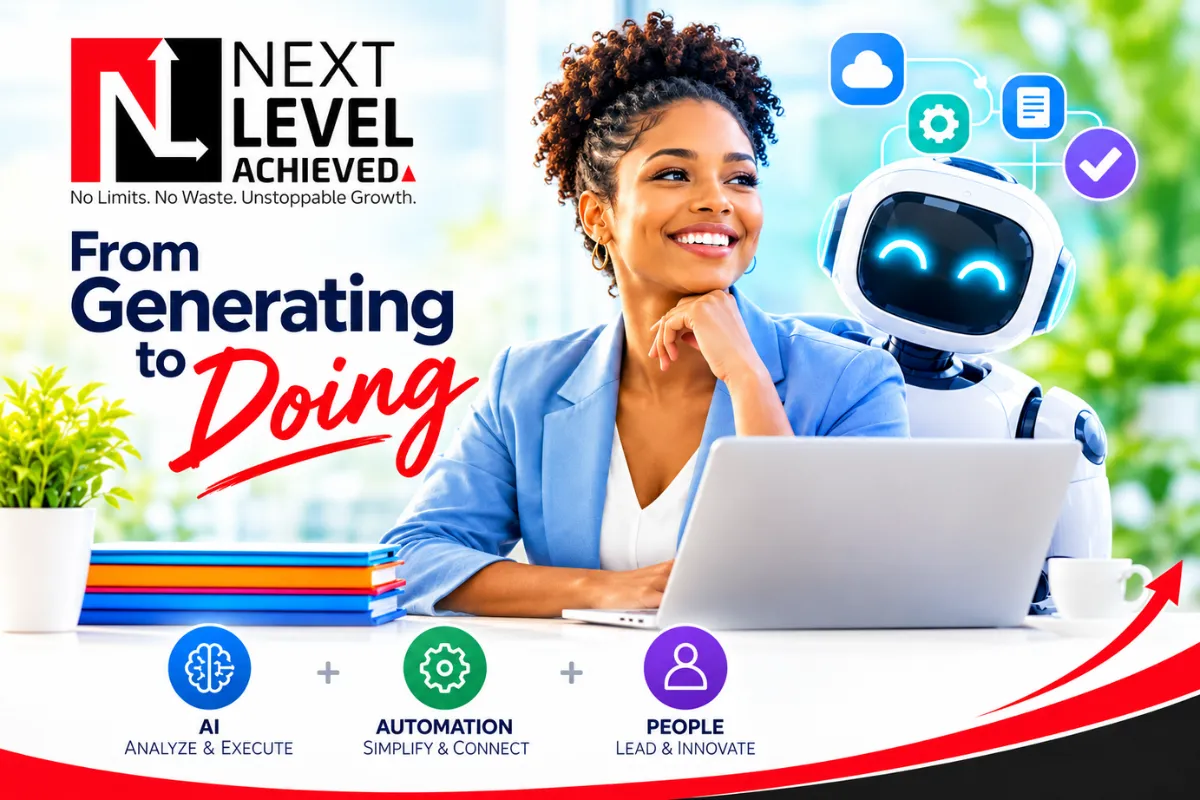
From Generating to Doing: AI, Automation & People
The Next Phase of AI: From Generating Content to Taking Action
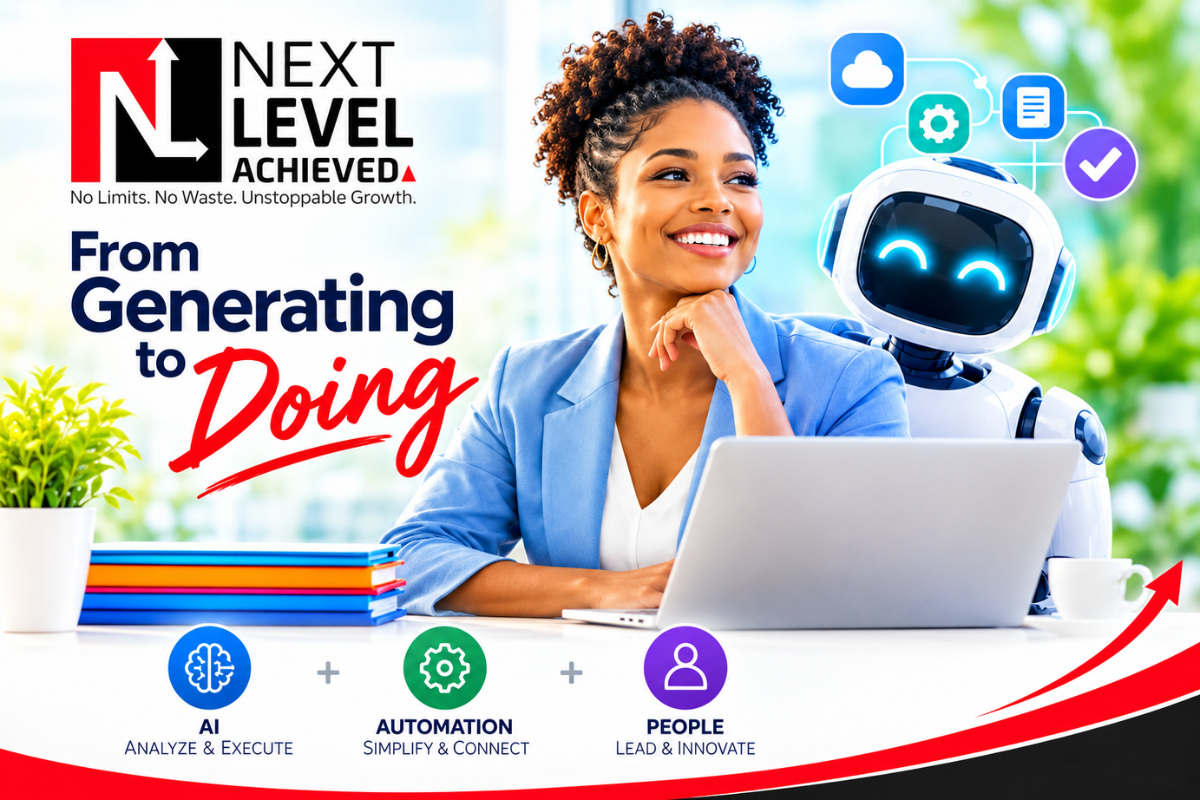
The first wave of generative artificial intelligence transformed how businesses create and consume information. AI could draft marketing copy, summarize documents, generate software code, analyze information, and produce synthetic media in seconds.
But content generation was only the beginning.
The next phase of AI is moving beyond generating information to taking action.
AI systems are increasingly being designed to interact with software, coordinate workflows, retrieve and analyze information, make context-based decisions, and execute defined tasks. This evolution—often described through terms such as AI agents, agentic AI, and intelligent automation—could fundamentally change how organizations structure work.
The important question for business leaders is no longer simply:
"What can AI create?"
It is increasingly:
"What can AI help us accomplish?"
1. From Passive Assistance to Active Execution
Early generative AI tools primarily functioned as assistants. A person would ask a question, receive an answer, review the output, and then manually complete the next step.
For example, an employee might ask AI to summarize a customer email. The employee would then copy the relevant information into a CRM, notify another department, create a follow-up task, and send a response.
Agentic AI introduces the possibility of connecting these steps into a larger workflow.
Instead of simply generating a response, an AI-enabled system may be able to:
Retrieve information from multiple business systems
Analyze incoming requests
Update records
Route tasks to the appropriate department
Generate and send approved communications
Monitor workflow status
Trigger additional actions when predefined conditions are met
Escalate exceptions to a human decision-maker
This represents an important shift: AI moves from being a tool people consult to becoming a component within the operational workflow itself.
The goal is not necessarily to remove people from the process. Instead, it is to reduce the amount of manual coordination required between people, systems, and repetitive tasks.
2. AI + Automation Creates a Different Kind of Productivity
AI becomes particularly powerful when combined with automation.
Generative AI can interpret information, summarize content, classify requests, or generate a response. Automation can then move information between systems and trigger the next step.
Together, they can create workflows that operate continuously rather than waiting for a person to manually initiate every action.
Consider a simple example:
Customer inquiry → AI analyzes request → Information is retrieved → Response is prepared → CRM is updated → Follow-up task is created → Human reviews exceptions
This type of workflow can reduce repetitive administrative work and shorten the time between one operational step and the next.
Research from McKinsey has estimated that generative AI could contribute substantial productivity value across business functions, while other research has examined significant productivity improvements in specific AI-assisted work environments. The exact impact varies considerably by industry, task, implementation quality, and level of human oversight.
That distinction matters.
AI does not automatically create productivity. Well-designed workflows do.
3. The Real Opportunity: Unbundling Work
One of the most important changes AI may bring to organizations is the ability to reconsider how jobs are structured.
Many jobs are not single activities. They are collections of different tasks.
A manager, for example, may spend part of the day:
Collecting information
Updating spreadsheets
Writing routine emails
Preparing reports
Reviewing documents
Attending meetings
Solving complex problems
Coaching employees
Negotiating with stakeholders
Making strategic decisions
AI and automation may be able to assist with some of the first group of activities while leaving the more complex human responsibilities largely intact.
This creates an opportunity to unbundle work.
Instead of asking, "Can AI replace this job?" organizations can ask a more useful question:
"Which parts of this job should be performed by technology, and which parts require human judgment?"
That distinction changes the conversation from job replacement to work redesign.
4. Creating More Space for the Human Premium
As automation handles more routine information-processing activities, distinctly human capabilities may become even more important.
These include:
Strategic Thinking
Leaders will still need to determine what the organization should do, why it should do it, and what risks it is willing to accept.
Judgment
AI can identify patterns and provide recommendations, but important decisions often require context, accountability, and an understanding of consequences.
Creativity
Organizations will continue to need people who can develop new ideas, challenge assumptions, and identify opportunities that are not obvious from historical data.
Leadership
Technology cannot eliminate the need to build trust, communicate a vision, resolve conflicts, and bring people together around common objectives.
Empathy and Relationship Management
Customer relationships, employee engagement, negotiation, and stakeholder management often depend on understanding human emotions and circumstances.
The emerging model is therefore not simply human versus machine.
It is increasingly:
Human judgment + AI capability + automated execution.
5. The 2026 Leadership Challenge: Redesign the Workflow
For business leaders, adopting AI should not begin with purchasing another AI application.
It should begin with understanding the organization's work.
Step 1: Map the Workflow
Identify repetitive processes that involve substantial amounts of:
Data entry
Information retrieval
Document processing
Scheduling
Reporting
Customer follow-up
Internal routing
Administrative coordination
Step 2: Separate Tasks by Risk and Complexity
Not every task should be automated.
A useful framework is to distinguish between:
Low-risk, repetitive tasks
Good candidates for automation.
AI-assisted tasks
Tasks where AI can prepare, summarize, classify, or recommend while a person remains responsible.
High-risk decisions
Activities that require meaningful human oversight, approval, accountability, or professional judgment.
Step 3: Establish Human Oversight
Autonomous execution requires boundaries.
Organizations should define:
What the AI is allowed to do
What information it can access
Which actions require approval
When a workflow must escalate to a human
How decisions are logged
How errors are detected and corrected
This is where AI governance becomes essential.
Step 4: Measure Outcomes
Successful AI adoption should be measured by business outcomes—not simply by how many AI tools an organization has deployed.
Useful metrics may include:
Time saved
Processing speed
Error rates
Customer response time
Employee capacity
Cost per transaction
Workflow completion rates
Quality and compliance measures
The objective is not to automate everything.
The objective is to make the organization work better.
6. AI Agents Will Not Eliminate the Need for Strategy
The growing interest in AI agents can sometimes create the impression that organizations will soon operate entirely autonomously.
That is unlikely to be the right way to think about the technology.
The more capable AI systems become, the more important it becomes to establish clear objectives, boundaries, governance, and accountability.
An AI agent may be able to execute a workflow, but leadership still determines:
What should the workflow accomplish?
What decisions should remain human?
What risks are acceptable?
What information should the system be permitted to access?
Who is accountable when something goes wrong?
These are leadership questions—not simply technology questions.
7. Preparing for the Agentic Enterprise
Organizations preparing for the next phase of AI should consider three priorities.
Build AI Literacy
Employees need to understand not only how to use AI, but also how to evaluate its outputs, recognize limitations, protect sensitive information, and work effectively with AI-enabled systems.
Redesign Processes
Simply adding AI to an inefficient process may automate inefficiency.
Organizations should first examine the workflow and then determine where AI and automation can create measurable value.
Develop Responsible AI Governance
As AI systems gain the ability to take action, governance must evolve accordingly.
Organizations need clear policies covering access, privacy, security, human oversight, documentation, testing, monitoring, and accountability.
The Future Is Not Just Generative. It Is Operational.
The first era of generative AI taught organizations that machines can create.
The next era will increasingly demonstrate that AI systems can participate in work.
They can interpret information, coordinate processes, interact with software, and execute defined actions.
But the organizations that benefit most will not necessarily be those that automate the greatest number of tasks.
They will be the organizations that understand where automation creates value, where human judgment remains essential, and how the two can work together responsibly.
The future of AI is therefore not simply about replacing human activity.
It is about redesigning work around the strengths of both humans and machines.
AI can increasingly handle information, repetition, coordination, and execution.
People remain essential for purpose, judgment, creativity, leadership, relationships, and accountability.
The next competitive advantage may come from knowing how to connect all of these capabilities into one intelligent operating model.
Next Level Achieved
AI Governance • Data Ethics • Enterprise Automation • Human + AI Collaboration
📍 Pembroke Pines • Miramar • Weston • Sunrise • Davie
🌐 nextlevelachieved.com
#AIAgents #AgenticAI #AIandAutomation #FutureOfWork #AIGovernance #BusinessStrategy #Leadership #EnterpriseAI #DigitalTransformation
