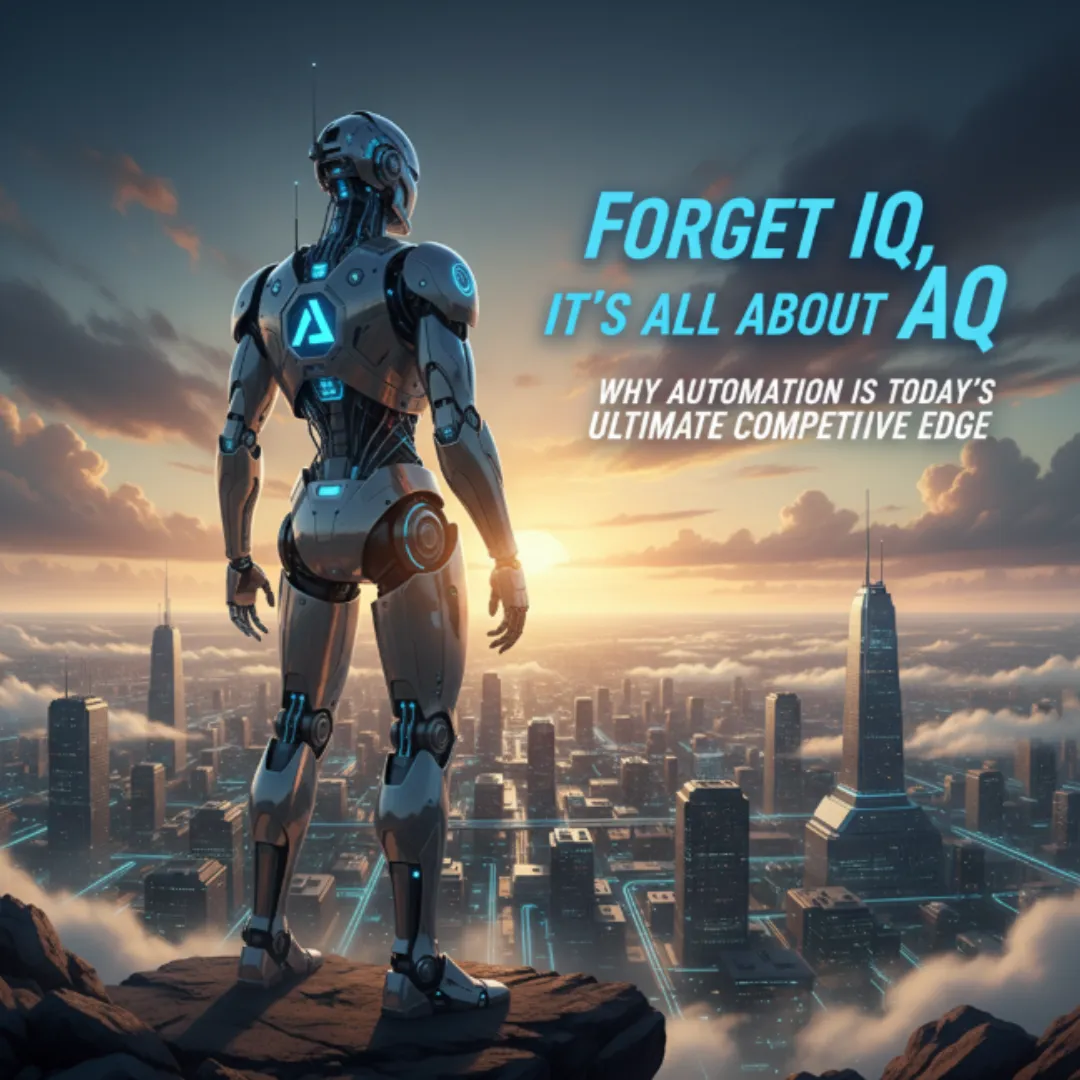
Forget IQ, It’s All About AQ: Why Automation Is Today’s Ultimate Competitive Edge
Forget IQ, It's All About AQ:
Why Automation is Today's Ultimate Competitive Edge

The old adage about intelligence being key? Cute, but in today's breakneck business world, raw brainpower isn't the competitive edge you think it is. While a high IQ might help you understand complex algorithms, it won't necessarily make your business thrive in the face of rapid technological advancements.
The real game-changer, the ultimate superpower transforming how businesses win, isn't IQ — it's Automation Quotient (AQ). It's not just a fancy tech trend; it's the engine driving speed, innovation, and market dominance. So, buckle up as we trace its journey, unpack its current reign, peek at the tricky bits, and fast-forward to its mind-blowing future.
Visualizing the intricate network of automation driving modern business efficiency.
What Exactly is This "Automation" Everyone's Talking About?
Forget those images of hulking robots welding car parts. Automation is far broader, a subtler, yet equally potent force. It's more than just a factory arm! Think software streamlining your boring paperwork, freeing up your brilliant human team. The big idea, stripped bare, is leveraging technology to make operations faster, smoother, and with significantly less manual grind. It's about letting machines handle the repetitive so people can handle the remarkable.
🤖RPA (Robotic Process Automation) :Your digital desk assistant, mimicking human clicks and keystrokes.
⚙️BPM Software (Business Process Management): The maestro conducting your entire operational orchestra.
🧠Intelligent Automation (IA):When AI and Machine Learning give RPA a brain-boost – systems that learn and adapt!
📊Workflow Automation:Keeping information flowing seamlessly across tasks and teams.
Why You Can't Afford to Ignore It: The Jaw-Dropping Benefits
Here's the crux of it: automation isn't some optional upgrade; it's your new competitive playbook. Ignoring it is akin to showing up to a Formula 1 race with a horse-drawn carriage. The core message? Automation isn't just about cutting costs; it's about building a strategic powerhouse, an entity capable of outmaneuvering competitors with ease.
🚀Speed Demon: Tasks done at warp speed, 24/7 (think 25-30% productivity boosts).
💰Money Talks :Massive cost savings, with some seeing 30-200% ROI in year one! Bye-bye overtime for manual data entry.
✅Error-Free Zone : Drastically fewer "oops" moments than human hands can achieve.
💪Flexibility Hero : Scaling operations up or down without breaking a sweat, responding to market shifts instantly.
😊Happy Customers : Faster service, personalized experiences, and quicker query resolution.
📈Smart Decisions, Not Gut Feelings : Data-driven insights, free from human biases.
🧑💻Happy Employees : Automate the tedious, liberate your team for strategic, creative, high-value work.
From Water Wheels to AI: A Whirlwind Tour Through Automation's History
Early Beginnings (Water Clocks & Mills)
Believe it or not, automation began with rudimentary devices like water clocks and mills. Humans have always sought efficiency!
Industrial Revolution (17th-19th C)
Steam engines, power looms, spinning jennies – the original disruptors. Oliver Evans' automatic flour mill (1785) showed "lights-out" production centuries ago.
Ford's Assembly Line & Mass Production (Early 20th C)
Eli Whitney's interchangeable parts, electricity, and Henry Ford's revolutionary approach to churning out Model Ts. The era of doingmorewithless time.
Rise of the Machines (Mid-20th C)
From industrial controllers to the birth of the first industrial robot, Unimate, in a GM plant (1961). Factories started getting seriously smart.
Digital Revolution (1980s-1990s)
Personal computers, the internet, and digital automation sweeping into offices, transforming communication, finance, and more.
The Intelligent Age (21st C & Now)
AI, Machine Learning, and Industry 4.0 fuse to create truly "smart factories" and cognitive automation. We've come a LONG way, but the goal remains the same: competitive advantage.
The undeniable thread throughout history is that those who embraced automation always gained an edge.
The Automation Verdict: It's Not an Option, It's a Necessity
Overwhelmingly, experts agree: automation has moved past "nice-to-have" to "must-have." Some even call AI automation a "survival strategy."
The numbers don't lie: Companies are reporting staggering productivity gains, higher profit margins, and a direct increase in revenue. A staggering 90% of SMBs are planning automation to stay competitive. The shift is palpable. The focus isn't just on doing thingsfaster, but on doingnew things– transforming entire customer journeys and business models.
We're entering the age of Intelligent Automation & Autonomous Business: AI and ML are pushing automation into realms where systems can learn, make decisions, and operate with minimal human oversight.
Strategic Imperatives:
✨Identify the right processes.
💡Invest in the right tech.
🧑🤝🧑Empower workforce to adapt and thrive.
Businesses need a clear strategy.
The Robot in the Room: Controversies and Sticky Situations
Let's address the elephant in the server room. Automation, while powerful, comes with its own set of challenges and ethical considerations that must be navigated thoughtfully.
⚠️Job Displacement
"Are robots taking our jobs?" McKinsey estimates up to 800 million jobs could be displaced by 2030, necessitating massive reskilling efforts.
⚖️Wealth Gap Debate
Does automation disproportionately benefit those who own or design the technology, widening economic inequality?
⚫Black Box Blues
When AI makes decisions, but its logic is opaque, how do we trust or audit a system whose reasoning we can't fully trace?
⛔Automation Bias
Humans becoming too reliant, uncritically accepting potentially flawed AI suggestions.
🚫Unintended Bias
AI systems trained on imperfect or biased data can lead to discriminatory outcomes in areas like hiring or lending.
🔒Privacy Panic
As automation relies on vast amounts of data, concerns about surveillance and mishandling personal information grow.
🤝The "Middle Ground" Argument
Many argue that AI and human labor are complementary, creating new roles and augmenting human capabilities rather than simply replacing them.
🚧Other Headaches
High upfront implementation costs, over-reliance risk, and the "poor process, poor automation" trap.
Fasten Your Seatbelts: The Wild Future of Automation
Innovation will be the ultimate differentiator. The competitive landscape will be dominated by those who innovate and seamlessly integrate cutting-edge automation.
🚀Robots, Robots Everywhere
The robotics market is exploding ($111B by 2030!). Expect more industrial robots, collaborative "cobots" working alongside humans, and even advanced humanoid robots taking on warehouse tasks. Mobile robots will dominate sales.
🌐Automation for Everyone
As robots become more affordable and user-friendly (hello, Robotics-as-a-Service!), even small and mid-sized businesses can jump into the automation game, intensifying competition across the board.
✨Hyperautomation: Automating entire end-to-end business processes.
👤Digital Twins: Virtual replicas of physical assets for real-time simulation and optimization.
💡Generative AI:Suggesting new manufacturing solutions and accelerating product development.
🤖Agentic AI: AI agents mediating 90% of B2B buying by 2028 – prepare for AI-to-AI transactions!
📊IoT & Big Data: Every machine talking to every other machine, generating insights for predictive maintenance and optimization.
💻Low-Code/No-Code Platforms: Democratizing automation, allowing "citizen developers" to build AI-infused apps.
🔒Cybersecurity in Automation: A critical and growing concern as systems become more interconnected.
VISIONThe Grand Vision for the Next Decade:
Blended Human-AI Teams:Humans focusing on creativity and critical thinking, AI handling routine and complex data tasks.
Autonomous Operations:Fully autonomous factories that self-monitor, self-decide, and even self-repair. Self-driving logistics with drones and vehicles.
AI Proficiency in Hiring:Expect 75% of hiring processes to include testing for workplace AI proficiency by 2027.
Growth Across Diverse Sectors:Healthcare (AI-powered robots in surgery), pharma, EV, food & beverage, electronics – automation will touch every industry.
Continuous Ethical Evolution:Ongoing focus on governance, privacy, and bias to ensure responsible AI adoption.
Conclusion: Automate or Be Left Behind!
Automation isn't just a buzzword; it's a historical force, now supercharged by AI, that provides the ultimate competitive edge. It boosts efficiency, cuts costs, delights customers, and unlocks human potential.
The future isn't aboutifyou automate, buthow wiselyandresponsiblyyou embrace this incredible power. Get strategic, get automated, and get ready to lead the pack!
