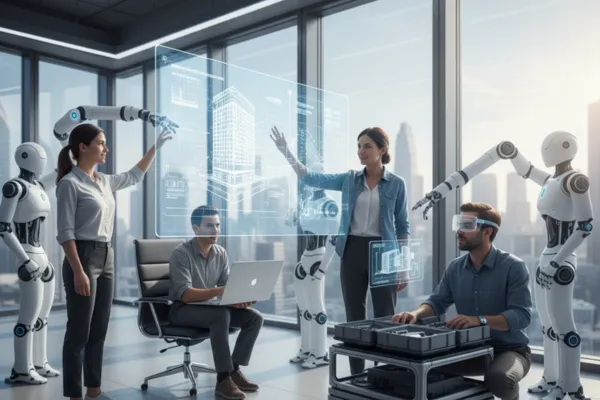
Beyond Efficiency: How Automation Unlocks Human Creativity and Innovation
Beyond Efficiency: How Automation Unleashes Human Superpowers (and What it Means for You!)

Introduction: More Than Just Robots on the Assembly Line
Are robots just taking our jobs, or are they actually helping us unlock our inner geniuses? It's a question that hums with both anxiety and exhilarating possibility.
The big idea? Automation isn't merely about shaving milliseconds off production times or cutting costs. It's about a seismic shift in how we, as humans, innovate, create, and grapple with the planet's most pressing problems. It's about augmentation, not replacement.
In this post, we'll embark on a whirlwind tour. First, a historical jaunt to understand how we arrived at this automated precipice. Then, a deep dive into the ways automation is turbocharging innovation, followed by a frank discussion of the ethical quicksand and potential pitfalls. Finally, we'll gaze into the crystal ball to discern the contours of our increasingly automated future.
A Walk Through Time: From Water Wheels to AI Brains
The urge to automate isn't a modern phenomenon. The O.G. automators were the ingenious minds that crafted ancient water wheels and intricate mechanical toys. These weren't just whimsical creations; they represented humanity's innate desire to delegate the mundane and harness natural forces.
The Industrial Revolution, a period of profound upheaval, witnessed the rise of "muscle automation." Steam engines, power looms, and Henry Ford's assembly line epitomized this era, focusing on large-scale production. The very term "automation" was birthed during this period, a testament to the transformative power of machines.
The Digital Dawn brought a new kind of automation, one fueled by silicon and code. Computers, early robots like Unimate, and programmable logic controllers introduced precision and flexibility. We began to imbue machines with a semblance of thought, a nascent form of artificial intelligence.
Today's Tech Tsunami is a convergence of powerful forces: Artificial intelligence, machine learning, collaborative robots (cobots), the Internet of Things (IoT), digital twins, and hyperautomation. It's no longer just about automating individual tasks, but about creating intelligent, interconnected systems that can learn, adapt, and even anticipate our needs.
The Innovation Engine: How Automation Makes Us Smarter, Not Lazier
The core promise of automation lies in its ability to liberate us from the shackles of repetitive, soul-crushing busywork. Machines can handle the tedious tasks, freeing up our cognitive bandwidth for creative problem-solving, strategic thinking, and the pursuit of groundbreaking innovations.
Consider the implications for product development. Automation enables rapid prototyping and testing, allowing us to build, iterate, and refine our ideas at unprecedented speeds. The ability to fail fast and learn from our mistakes is crucial for driving innovation.
Data is the lifeblood of innovation, and automated systems are voracious consumers and generators of data. They can sift through vast datasets, identify patterns, and extract insights that would be impossible for humans to discern. This is like having a super-powered research assistant who never sleeps.
Moreover, machines excel at consistency and precision. They minimize errors and ensure consistent quality, providing a solid foundation for building innovative products and services.
Automation also empowers businesses to scale rapidly without straining their human resources. This agility is essential for navigating the ever-changing market landscape.
The future of work is not about humans being replaced by machines but about humans and AI working in harmony. AI can augment our abilities, handling the grunt work and allowing us to focus on strategy, creativity, and complex problem-solving.
The Elephant in the Server Room: Debates, Drawbacks, and "Uh-Oh" Moments
The most pressing concern surrounding automation is the potential displacement of human workers. While history suggests that new technologies ultimately create more jobs than they destroy, the transition can be painful and disruptive. The need for reskilling and upskilling initiatives is paramount.
Ethical considerations also loom large. Bias in algorithms can perpetuate and amplify existing societal inequalities, leading to unfair outcomes in hiring, lending, and other critical areas. Ensuring transparency and accountability in AI decision-making is crucial.
The increasing collection and analysis of data raise serious privacy concerns. We must strike a balance between the benefits of automation and the need to protect individual privacy.
Over-reliance on automation can also lead to a decline in human skills. What happens when the system fails, and we've forgotten how to perform tasks manually? We must ensure that we maintain a baseline level of competence in essential skills.
The initial investment in automation technologies can be substantial, posing a barrier for smaller businesses and organizations. We need to find ways to make automation more accessible and affordable.
Finally, the environmental impact of automation cannot be ignored. Data centers and robots consume significant amounts of energy and require rare earth minerals. We must strive to make automation more sustainable.
Glimpse into Tomorrow: What's Next for Our Automated Future?
Looking ahead, we can expect AI and machine learning to become even more pervasive and integrated into every aspect of our lives. "Agentic AI," capable of handling multi-step tasks autonomously, will become increasingly common.
Collaborative robots will become even more adept at working alongside humans, enhancing productivity and safety in various industries.
Digital twins, virtual replicas of real-world systems, will enable us to simulate, monitor, and optimize processes before they even occur.
Generative AI, which can create new designs, manufacturing solutions, and even content, will accelerate product development and unleash a wave of creativity.
Virtual and augmented reality will transform how we work, learn, shop, and socialize.
Sustainability will become a core driver of automation, with technologies being used to optimize energy consumption, reduce waste, and build a greener future.
The nature of work will continue to evolve, demanding new skills and emphasizing human-machine collaboration and continuous learning.
Conclusion: Innovate or Be Left Behind
Automation is a powerful engine of innovation, providing us with the time, tools, and insights to push the boundaries of what's possible.
However, we must embrace the future responsibly, addressing ethical concerns and ensuring that our workforce is prepared for the changes ahead.
Don't just automate for the sake of efficiency. Automate to unlock human potential and drive truly groundbreaking innovation. Are you ready to supercharge your creativity?
